Geologic Sadness
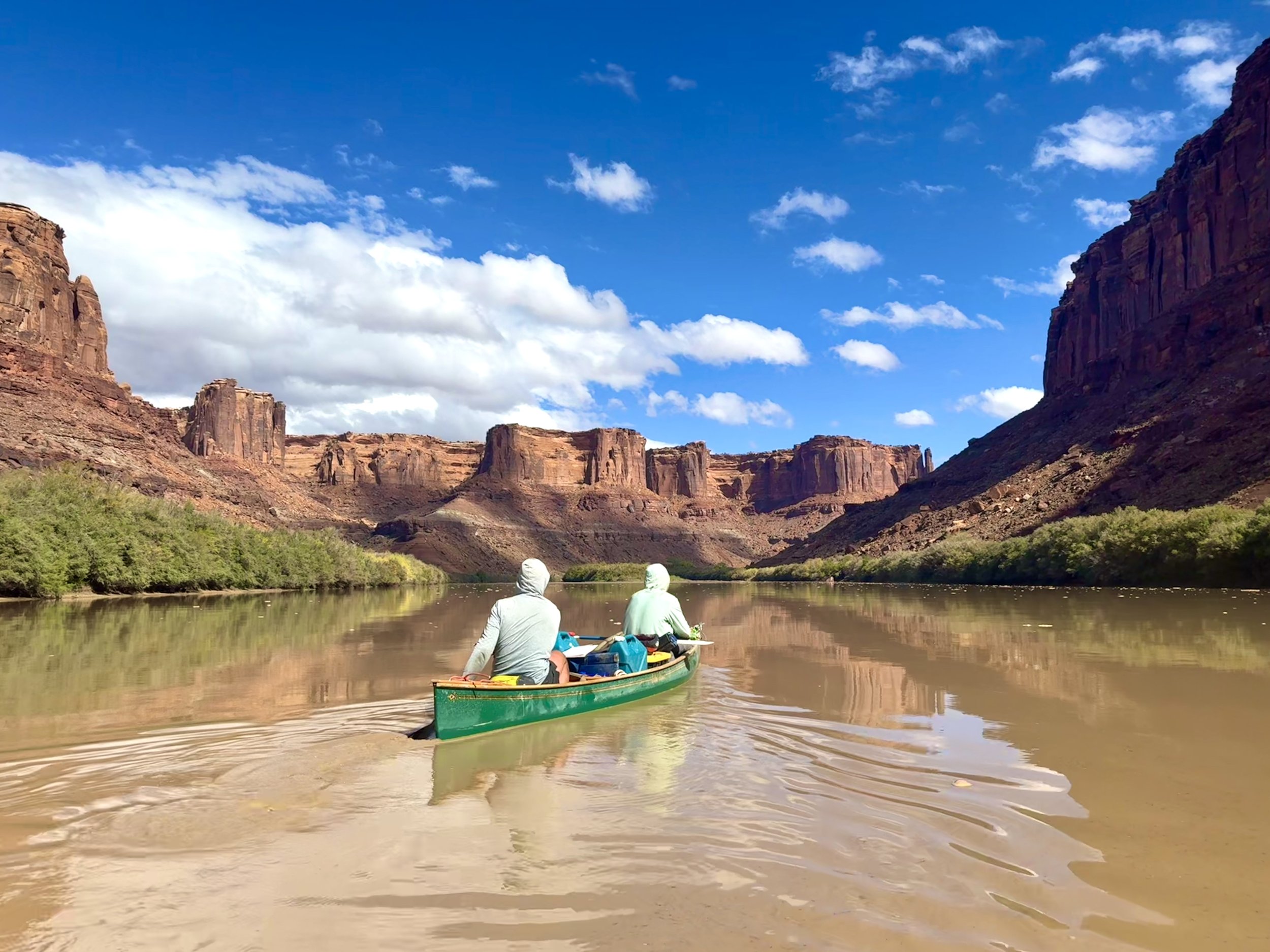
My brother invited me on a canoe trip this summer. The goal was to paddle down the Green River in Utah to its confluence with the Colorado. It turned out to be a great trip, and a great metaphor for depression. (I wouldn’t go on a vacation with a therapist either.)
We started in a tiny town in the uninhabited high desert of Utah, driving down a Main Street, past a dollar store and a few fast food joints, into a park, then, finally, rumbled to rest on a boat ramp to greet the aptly named river. There was a pleasant quaintness, even a blandness, to the scene. It was anywhere America. A catfishing tournament was running off the launch and camouflaged men and their children sat in tranquility, chatting and waiting for a bite. On the fields of grass families were arriving, scoping for a plot to set up on and enjoy the day. The river swept by anonymously, an afterthought, even to the anglers whose lines were dipped in its waters.
Setting off down the river, quickly the scene began to change. Ripples of rock began running along the bank, undulating but growing taller the further downriver we got. Soon the vanishing expanse of the desert disappeared behind these walls and we found ourselves waiting for the odd chip or break in the wall to steal a glance out.
I mentioned it was my brother who invited me on this trip. Our dad died 15 years ago due to cancer and he had spent the rest of our childhood with a degenerative disease known as Multiple Sclerosis. In his youth, and in a buried yearning which never left, he was a canoeist. This trip held special meaning as a reunion of his two sons on the water. My brother had also acquired a green Old Town, the very same canoe that our father had stored in our garage until my mom gave away after his death, though his was a beautiful wooden version which he used to take paddling down the various waterways of upstate New York with childhood friends.
We took a picture of my brother and I together in the Old Town, noting that our mom especially would appreciate it. My brother might have offered some quick remembrance on some other day of the trip. And, that was it. That was the way things were with my dad, his death and disease. Things were sometimes spoken, but really, what was there to say. It was all so immense, and sad. It was not so much avoidance as capitulation to the bigness of it, the impossibility of capturing and conveying in language the extent of what we felt.
Miles passed and the walls of rock continued to grow taller, us smaller, continued their ascent, us our descent, such was the dizzying effect. That first ripple of rock had grown until it formed a continuous band and then a new ripple, distinct in color or texture, would begin to undulate and swell at the bottom of that original band until it too was pushed up from below. The walls grew this way until they were each a five thousand foot tall slice of layer cake in every shade of red. We knew enough high school science to understand that each layer represented an epoch of time, its unique characteristics forged by the environment it was in (covered in ocean, bubbling in magma, etc.). You couldn’t help but be moved by it, millions of years, all the life it contained, compressed and on display.
In this grandness, the immensity of so much in so little, which was still so much, something was dislodged in me and I began to feel a little more free. I connected, briefly, with the lost epochs with my dad that had become so layered, and dense and subsurface that words could never reach them. And that is what depression is, densely layered feelings that crush you under their weight so you are desperate, hopeless and alone. I have lived so much of my life trying to be okay, trying to picnic in the park or plunk my line in the water and doze off, that I neglected to venture downriver, down time, down into the colossal striated walls of my loss. I can’t fault myself for trying to be okay, and many times I was okay and did have fun. But, I know there is still something great under the surface and I am missing something awesome and elemental if I do not go to it.
Termination: On Grief and Loss in Therapy
We therapists commonly refer to the ending of our work with a client as a ”termination,” as if the client were a bug and we are their psychological exterminator, here to eliminate their problem and ultimately them forever. This grim choice of word is illustrative of the difficulty both therapist and client have with the ending phase of therapy. Termination does describe an ending, but one that is sudden and severe, as if the best way to deal with the loss is to simply sever from it completely. Though this word may reflect accurately the pain that is involved with ending a therapeutic relationship, it does not speak to the vital and reparative aspect of saying goodbye. This saying goodbye is every bit as important as any other phase of therapy and can be a truly transformative experience for those that complete it.
When we talk about the ending of therapy we are really talking about the loss of a relationship. And, if the client and therapist have been seeing each other for sufficiently long the client will be losing a relationship with tremendous intimacy, trust, even dependence. This is fertile therapeutic soil.
Most people have wounds in their life from loss. To start, our culture seems to be terrified of loss and creates a milieu that fosters an unhealthy relationship to it: see our obsession with the young and the new; ghosting as a nearly-normalized way to end a romantic relationship; the political convulsions our nation is undergoing as some attempt to cling to a dead and romanticized past while others advocate moving on without consideration for what their fellow citizens are leaving behind.
Then, there are the infinite wrinkles of individual experience of unresolved loss: a child is forced to experience the loss that is an abusive parent while still needing to clutch desperately to that parent as they are the only available source of love and nurturing; a loved one dies tragically and you are unable to say goodbye; a romantic partner betrays you and the searing of that pain causes you to immediately eject and protect yourself.
These unresolved losses have a special way of layering and densifying- loss compounds. But, what happens when scar tissue stops serving to protect our wounds and prevents us from feeling when we reach out to touch the world.
Saying goodbye to a therapist you have attached to inevitably brings these unresolved losses to the surface, like an earthquake erupting a string of dormant volcanoes. The client can then deal with these losses and learn to say goodbye in a way that is not arrested or incomplete or terminal. This starts with processing the loss of the therapist and the void that will be when they are gone. What needs to fill that void is not scabrous protective tissue covering raw open wound. The only thing that can fill that void is the relationship itself, the memories you have, good and bad (it must be everything), of what the relationship was. By learning to do this with the loss of the relationship with the therapist you may learn to do this with the other unresolved losses of your life. That is not an experience you would want to lose out on.